
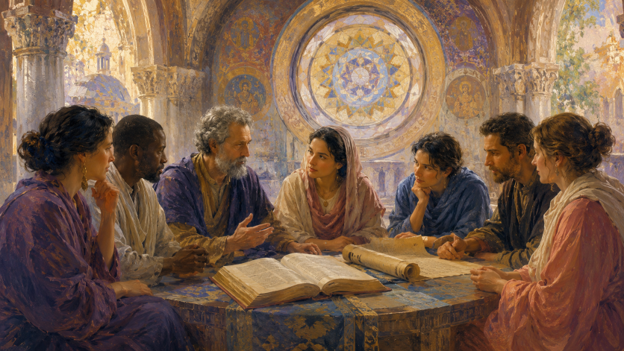
The Bible, and only the Bible, is the inspired Word of God. But the Creed is authoritative.
Here is why.
The Bible does not set its own Canon. It does not tell us which books belong in the Bible and which books do not. There is no inspired table of contents tucked between Malachi and Matthew, no apostolic appendix saying, “include Jude, exclude Clement.”
In the early centuries of Christianity, there were many books read, admired, copied, and considered by Christians. Some appeared on early canonical lists. Some were treated with great respect. The Didache, the Shepherd of Hermas, the Epistle of Clement, and other early Christian writings were not heretical or obvious frauds. Many were orthodox. Many were useful. Some were, at first glance, more impressive than several books that did make it into the New Testament.
Second John, Third John, Jude, and Philemon are inspired Scripture. But let us be honest: they do not enter the room with trumpets. Philemon is roughly the first-century equivalent of an email about an awkward personnel matter. Second and Third John are inspired, but they are not sprawling theological treatises. Jude is magnificent, though its close relationship to Second Peter has kept scholars confused for centuries.
And yet the Church said: these belong.
The Church also said: the Didache does not. The Shepherd of Hermas does not. Clement does not. Other ancient, useful, and sometimes deeply impressive Christian writings do not.
That was not a casual editorial decision. It was an authoritative act.
The Church — the original Church, the undivided Church, founded by Christ and guided by the Holy Spirit — recognized the Canon of Scripture. It did not make Scripture inspired. God did that. But it recognized which writings were inspired and belonged to the Apostolic Canon.
That same Church also confessed the Creed.
In fact, the Church confessed the Creed before the twenty-seven-book New Testament was universally settled in the life of the Church. Nicaea met in AD 325. Athanasius gave the first known exact list of the twenty-seven New Testament books in AD 367, and the councils of Rome, Hippo, and Carthage followed later in the fourth century. The Creed was not a later decoration added to biblical Christianity. It was the Church’s authoritative confession of what biblical Christianity is.
This is the point many Christians miss. The Bible is inspired. The Canon is authoritative because, without an authoritative canon, some inspired book might have been excluded and some merely human book might have been included. The Creed is authoritative for the same reason.
It is difficult to see how a Christian can confidently receive the twenty-seven-book New Testament while casually dismissing the Creed as merely “man-made tradition.” The same undivided Church that recognized the Canon also confessed the Creed. The same Church that said, “This is Scripture,” also said, “This is the faith.”
No canon means no identifiable Bible. No Creed means no identifiable orthodoxy.
To be clear, the Creed did not come before Scripture. It came before the universally settled recognition of the twenty-seven-book New Testament canon. The Church already had the Hebrew Scriptures, the apostolic writings, the Gospels, Paul’s letters, baptismal confessions, rules of faith, liturgy, and preaching.
Nor is the Creed above Scripture. The Creed is under Scripture, drawn from Scripture, and authoritative as the Church’s way of reading Scripture faithfully.
This offers Protestant and Evangelical theology two great advantages.
The first advantage is that the Creed gives Protestants, especially Evangelicals, a past.
This matters more than many realize. One of the weakest forms of Protestant theology is the kind that seems to begin with Luther, Calvin, Wesley, Moody, Billy Graham, or the founding pastor of whatever church currently has the best parking lot and the most assertive fog machine.
But Christianity did not begin in 1517. It did not begin in Geneva. It did not begin in Wittenberg. It did not begin in Azusa Street, Nashville, Dallas, Wheaton, or the back room of a Christian publishing house.
Christianity began with Christ, was preached by the Apostles, confessed by the martyrs, defended by the fathers, and handed down through the Church before any of our denominational names existed.
The Creed reminds Protestants that they have an inheritance older than Protestantism.
This does not make them Roman Catholic. It does not make them Eastern Orthodox. It does not require them to kiss an icon, buy a censer, learn Latin, or pretend to understand every sentence in Maximus the Confessor. It simply means that they are not rootless. They stand inside the ancient Christian faith, under Scripture, with the undivided Church.
That is not a betrayal of the Reformation. It is one of the Reformation’s better instincts.
The best Protestants did not set out to invent a new religion. They intended to reform the Church according to Scripture and the ancient faith. They appealed constantly to the fathers, the councils, and the early Church. They did not say, “Away with everything before 1517.” They said, in effect, “Let us return to the apostolic faith.”
The Creed helps Protestants say that with a straight face.
It says: we believe in one God, the Father almighty. We believe in one Lord Jesus Christ, true God from true God. We believe in the Holy Spirit, the Lord and giver of life. We believe in one holy catholic and apostolic Church. We believe in baptism, resurrection, judgment, and the life of the world to come.
This is not sectarian. This is not Roman. This is not Protestant. This is Christian.
The second advantage is that the Creed gives Protestants boundaries.
This matters because every heretic eventually learns to quote the Bible.
Arius quoted Scripture. The modalists quoted Scripture. The Gnostics quoted Scripture when it suited them and allegorized it when it did not. Modern prosperity preachers quote Scripture, usually just before explaining why the widow’s last twenty dollars should be sent to a man with a private jet. Every strange doctrine arrives with verses attached. Error rarely enters the church saying, “Good morning, I am error.” It usually arrives carrying a Bible and smiling like a youth pastor.
That is why “I just believe the Bible”, though noble in intent, is never quite right.
Of course Christians should believe the Bible. But the question is always: what does the Bible teach? The Creed answers that question at the most basic level. It does not answer every question. It does not settle every dispute. It will not tell us the correct view of the millennium, the proper frequency of communion, the best form of church government, or whether the worship leader should tuck in his shirt.
But it does tell us the boundaries of Christian confession.
If someone denies the Trinity, he is outside the Creed. If someone denies the full deity of Christ, he is outside the Creed. If someone denies the Incarnation, the bodily resurrection, the final judgment, or the life of the world to come, he is outside the Creed.
He may still quote the Bible. He may still use Christian words. He may still have a podcast, a conference, a publisher, and a very serious headshot in which he appears to have just discovered a tragic truth hidden from everyone else for nineteen centuries.
But he is outside the Creed.
That matters.
The Creed does not replace Scripture. It protects the Church from misreadings of Scripture that the Church has already rejected. It is not a cage placed around the Bible. It is a fence placed around the sheep.
This is why the Creed is especially useful in our age. We live in a time when many Christians are suspicious of authority but strangely vulnerable to novelty. They distrust creeds and councils, but will receive theology from a stranger with a microphone and a monetized channel called something like The Real Truth About Everything.
The Creed is a mercy against this nonsense.
It says to the restless, the clever, the bored, the contrarian, and the spiritually ambitious: you may think you have discovered something new, but the Church has heard this before. The labels have changed. The lighting is better. The heresy has a logo now. But the thing itself is old.
The Creed also teaches humility. It reminds us that Christianity is received before it is analyzed. We do not build the faith from scratch each morning with a Bible, a notebook, and the confidence of a man assembling furniture without instructions. We receive the faith once delivered to the saints. We test all things by Scripture. But we do not pretend that we are the first Christians ever to read it.
This is not a small point.
A Christianity without the Creed becomes very vulnerable to tiny popes in baseball caps, prophets with poor impulse control, and entire churches built around one man’s ability to make ordinary doctrine sound like a conspiracy.
The Creed saves us from that.
It gives us a shared confession, a common grammar, a way of saying together what the Church has always meant when it says that Jesus is Lord.
This is why the Creed is not merely correct. It is authoritative.
Not inspired. Not equal to Scripture. Not above Scripture.
Authoritative.
It is authoritative because the Church that recognized the Canon also confessed the Creed. It is authoritative because it summarizes the apostolic faith. It is authoritative because it tells us what Christians mean when they say “God,” “Christ,” “Spirit,” “Church,” “salvation,” “resurrection,” and “life everlasting.”
Without it, the Bible remains inspired, but Christian identity becomes harder to name. With it, the Church can say, with clarity and confidence: this is the faith. This is the faith of the Apostles. This is the faith of the martyrs. This is the faith of the undivided Church. This is the faith by which we read the Scriptures, worship the Father, confess the Son, and live in the Holy Spirit.
The Bible, and only the Bible, is the inspired Word of God.
But the Creed is authoritative.
And Christians who love the Bible should be the first to say so.