
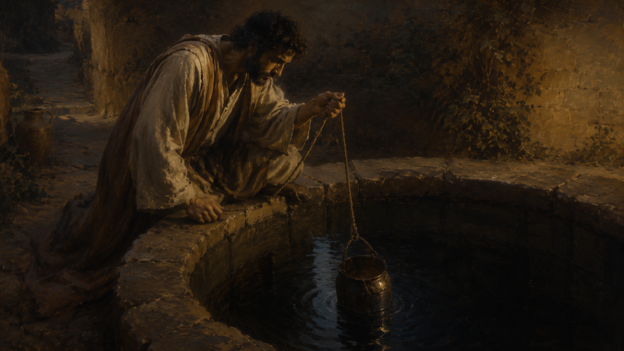
We are a mystery even to ourselves
“Counsel in the heart of man is like deep water,
but a man of understanding will draw it out.”
— Proverbs 20:5
Scripture presents the human heart as deep and difficult to know, even to ourselves. Wisdom involves patiently drawing out what lies beneath the surface: motives, fears, desires, intentions, memories, and thoughts.
We like to believe that we are rational creatures. This confidence survives despite overwhelming evidence to the contrary, including but not limited to procrastination, addiction, doomscrolling, revenge fantasies, and the existence of “just one more episode.”
The writers of Scripture were less surprised by this sort of thing than we are. The Bible does not treat a human being as a transparent creature, fully available to himself, calmly steering his conduct by reason. It assumes that the human heart is deep, obscure, layered, and difficult to govern. “Counsel in the heart of man is like deep water.” That is not the language of shallow optimism. It is the language of someone who has met people.
How often are we our own worst enemies?
Christianity adds a further complication. We are not merely finite; we are fallen. The intellect itself has been darkened. We do not possess complete access even to our own motives, desires, memories, or habits. This explains why self-control is difficult and why human beings are so frequently astonished by their own conduct. A man may sincerely resolve to behave virtuously at noon and be found at midnight eating cold cheesecake directly from the refrigerator while explaining to himself that this is somehow medicinal.
We are deep waters.
I would like to offer a handful of metaphors that have helped me understand myself and my own mind a little better.
Before I go on, you are right to become nervous whenever theology and what appears to be psychology appear in the same paragraph. I am not attempting to derive psychology from Scripture, nor theology from psychology, and certainly not theology from pop psychology, a discipline which has done to the human soul what fast food did to the American waistline. There is no psychology here.
These are merely metaphors, nothing more.
Jesus Himself showed us that metaphors aid understanding. In addition to His major parables, such as the Good Samaritan and the Prodigal Son, He filled His teaching with images: the mustard seed, the lost coin, the door, the light, the vine, the shepherd, the sheep, the house built on rock. Metaphor does not replace truth. It helps us see it.
From simplest to most complicated, these metaphors compare the mind to an iceberg, a warehouse, a television, a senate, and a train. They complement one another. Each illuminates a different aspect of mental life.
The Iceberg Metaphor
Imagine an iceberg floating in the sea.
Only a small portion can be seen above the surface. The vast majority lies below the waterline. The tip of the iceberg represents the conscious mind: the thoughts of which we are aware. The mass beneath the surface represents the non-conscious mind: the thoughts, desires, memories, instincts, habits, and fears that are part of us even when we are not directly aware of them.
This is the least original of the metaphors, but it remains useful because it is so obviously true. We often flatter ourselves that consciousness is the center of the mind. Experience suggests otherwise. Thoughts arise unbidden. Memories surface unexpectedly. Emotions appear before reasons are invented to justify them. Much of human life seems less like issuing commands and more like receiving reports from a distant province that has already begun rioting.
The iceberg reminds us of an uncomfortable fact: most of the mind operates beneath conscious awareness. We are acquainted only with the visible surface.
Unfortunately, modern society encourages the opposite belief. We are told constantly to “be ourselves,” despite the rather obvious problem that many people have not the faintest idea who that self actually is.
The iceberg teaches us that we are larger, stranger, and more dangerous than our conscious thoughts suggest.
The Warehouse Metaphor
Imagine a warehouse that is completely dark.
No light comes through any window or door. The warehouse is filled with objects, large and small. Some are scattered across the floor. Some are piled neatly on shelves. Some are easy to reach. Others are buried behind stacks of other things.
The only light in the warehouse is a small penlight. It can shine on only one object at a time. Each object represents a thought, memory, desire, fear, or feeling. The penlight represents conscious attention: the one thought of which you are presently aware.
The important point is that all the other objects remain in the warehouse whether the light is shining on them or not.
Some thoughts are easy to find because they are organized. This is why we can retrieve knowledge more easily when we truly understand it. Ordered thoughts are like well-labeled boxes on accessible shelves. Disorganized thoughts are like loose objects scattered across the floor in the dark.
Most importantly, some thoughts block other thoughts. Some objects are piled in front of other objects, preventing them from being seen. We may have done this deliberately, or semi-deliberately, because certain thoughts are too painful to face. These are repressed thoughts. But repression does not mean they have ceased to exist. They remain in the warehouse, and they can still affect how we behave.
This explains a number of strange human experiences. One may forget a memory for years and then suddenly recover it because some associated object has been moved aside. A seemingly minor event may provoke a disproportionate response because it has knocked over something larger in the dark.
The warehouse metaphor teaches that consciousness is not the creation of thoughts but the illumination of thoughts. Our thoughts are present in the mind even when we are not conscious of them. When the penlight shines on one object, that object becomes visible; but all the other objects remain.
It also teaches that the problem with memory is often not storage but retrieval. The object is there. The difficulty is finding it.
In Christian terms, this helps us understand the darkened intellect. Paul writes that men “became vain in their reasoning, and their senseless heart was darkened” (Romans 1:21). We do not even possess full access to all our own thoughts. Yet they remain part of us and continue to influence who we are and what we do.
The warehouse teaches us that we carry more than we can see.
The Television Metaphor
Imagine a television with a cable line feeding all the channels into it.
Each channel represents a thought. All the channels are flowing into the television at once, but the television can display only one channel at a time. The channel to which you are tuned represents your conscious thought.
Suppose you tune to channel 3 and watch the show for a while. Then you switch to channel 6 and watch that show. Later, you return to channel 3. The show on channel 3 has progressed. It did not freeze merely because you were watching channel 6.
This is what the television metaphor adds to the previous models: our thoughts continue even when we are not conscious of them.
We have all experienced this. If you are trying to make a major decision, people tell you to sleep on it. Why? Because the mind continues working on the problem even when conscious attention has turned elsewhere. Or someone says something and you think of the perfect reply three hours later. Or you cannot remember a word and say, “It’ll come to me.” Often it does.
You stopped consciously thinking about the problem, but the channel continued processing. Later, the answer appeared on the screen.
This metaphor explains sudden insights, dreams, intrusive thoughts, earworms, emotional processing, and why writers sometimes discover ideas rather than deliberately construct them. The unconscious is not merely a storage facility. It is active. It continues to develop thoughts outside the field of conscious attention.
The television teaches us that the mind keeps broadcasting even when we have changed the channel.
The Senate Metaphor
Imagine the mind as a senate or legislative chamber.
Each senator represents a thought, desire, fear, memory, habit, appetite, conviction, or impulse. Only one senator can speak at a time. The speaking senator represents conscious thought.
But just because one senator is speaking does not mean the others will vote his way.
This is the metaphor that best explains behavior. It is the least flattering to our pride, and therefore perhaps the most accurate.
We may tell ourselves, “When I get home, I am going to do my work.” We may repeat it with conviction. “I am going to do my work. I am going to do my work.” But before we know it, it is 8:00 p.m., the work is untouched, and we have acquired detailed knowledge of several pointless online controversies.
Or we may tell ourselves that we are going to mow the lawn, only to discover later that doomscrolling has made a theological argument out of the sunset and it is now too dark to mow.
I have seen this drama up close. I had a relative with lung cancer who had to carry an oxygen tank with him. He would regularly lift the mask from his face in order to light a cigarette. (Apparently oxygen tanks weren’t flammable back then.) He’s no longer with us. I have a friend whose diabetes is so severe that the doctors had to amputate part of his foot. Yet every meal is sugar, sugar, and more sugar. All of his doctors and all of his friends cannot persuade him to stop behavior that is essentially slow motion suicide. I suspect he cannot even persuade himself. I even know a handsome fellow who spends his time writing articles when he should be doing his real job.
Conscious thought is not the ruler of the mind. It is merely the currently audible advocate.
This explains why people so often act against their own declared beliefs. Conscious thought is influential, but not sovereign. Much of behavior is shaped by processes beneath awareness. We assume the thought we hear consciously is the thought in control, but the actual vote is happening elsewhere.
A senator gives a brilliant speech about dieting. The chamber applauds. But when the vote comes, appetite, fatigue, stress, and habit form a coalition and defeat the motion.
Paul understood this perfectly in Romans: “For the good that I would I do not: but the evil which I would not, that I do.”
The senate is often badly governed.
This metaphor explains why habits overpower intentions, why addictions persist, why emotions outvote reason, and why moral weakness feels internally divided. It also reminds us that self-control is not merely a matter of giving ourselves better speeches. It is a matter of reordering the chamber.
The senate teaches us that the conscious thought speaking in us is not always the thought that governs us.
The Train Metaphor
Imagine a train pulling cars through a tunnel.
Each car represents a thought, memory, emotion, or impulse. Each car becomes visible one by one as it emerges from the tunnel. The visible car represents the thought presently in consciousness. Yet the train already exists beyond what can currently be seen. More cars are coming. The cars are connected. Each pulls the next. Once the train has gained momentum, it becomes difficult to stop or redirect.
The train metaphor explains three features of mental life.
First, consciousness experiences thoughts sequentially. We encounter one thought after another, like train cars emerging from a tunnel. Even if many processes exist beneath awareness, conscious experience itself feels linear.
Second, thoughts are associative. One thought pulls another behind it. A memory evokes another memory. Anxiety summons related fears. A song, smell, phrase, or image may suddenly draw an entire chain of forgotten experiences behind it. The mind rarely moves randomly. It travels along tracks.
Third, thoughts possess momentum. Once a train is moving, it cannot stop instantly. In the same way, habits, emotional spirals, temptations, resentments, and desires often continue long after we consciously wish to halt them. Much of moral and spiritual discipline therefore involves not merely resisting individual thoughts, but redirecting the tracks on which the train runs.
Recovering alcoholics know this. The decision to drink has often been made long before the first drink of the day. It may happen at 2:00 p.m. when the boss yells, not at 6:00 p.m. when the person steps into the bar.
Moral formation therefore involves more than resisting isolated thoughts. It requires laying tracks.
The old spiritual disciplines suddenly appear less arbitrary under this model. Scripture, prayer, fasting, habit, fellowship, and worship are not merely rules. They are attempts to direct the train before it gathers speed toward unfortunate destinations.
We remain mysterious creatures. The modern world possesses astonishing technological power yet we cannot reliably prevent ourselves from doomscrolling at midnight while eating food whose packaging explicitly described it as “family size.”
The train teaches us that we are carried not merely by thoughts, but by patterns of thought unfolding through time.
In Christian terms, virtues become rails. Habits become routes. Prayer and Scripture reshape tracks. Sin becomes an entrenched pathway. Repentance becomes switching tracks before momentum carries the soul further.
Deep Waters
These metaphors fit together naturally.
The iceberg explains why consciousness reveals only a small fraction of the total system. The warehouse explains how thoughts exist outside awareness. The television explains how those thoughts continue developing dynamically. The senate explains how various thoughts and impulses compete to influence action. The train explains how thought is experienced through association and momentum.
Each metaphor answers a particular question.
How much of the mind is conscious? The iceberg answers: not very much.
Where are non-conscious thoughts? The warehouse answers: they are stored within us, even when unobserved.
What are non-conscious thoughts doing? The television answers: they are still developing.
How do thoughts influence behavior? The senate answers: they compete for votes.
How do we experience thought? The train answers: as a sequence of linked associations with momentum.
Does all of this really connect to Proverbs 20:5? I think so.
“Counsel in the heart of man is like deep water; but a man of understanding will draw it out.” This verse is psychologically rich, poetic, ancient, and metaphorical. It tells us that the mind is deeper than consciousness. It naturally connects to all five metaphors. There is deep water beneath conscious awareness. There are hidden contents waiting to be illuminated. There are thoughts continuing beneath awareness. There are motives and counsels influencing action. There are habits and associations shaping behavior before we fully see them.
Modern psychology did not discover the hidden depths of the mind. It created new metaphors for truths already observed in ancient wisdom literature. The human heart is deeper than introspection.
What, then, is the solution to the mystery of ourselves?
Scripture offers several answers, and they are simpler than we may wish them to be: the Bible, prayer, fellowship, worship, confession, perhaps fasting, and the sacraments depending on your theology. Above all, we ask for God’s grace, because grace does not merely pardon us. Grace instructs us.
“For the grace of God has appeared, bringing salvation to all men, instructing us to the intent that, denying ungodliness and worldly lusts, we would live soberly, righteously, and godly in this present age.”
— Titus 2:11–12
The heart is deep water. But grace teaches us how to draw from the well.