
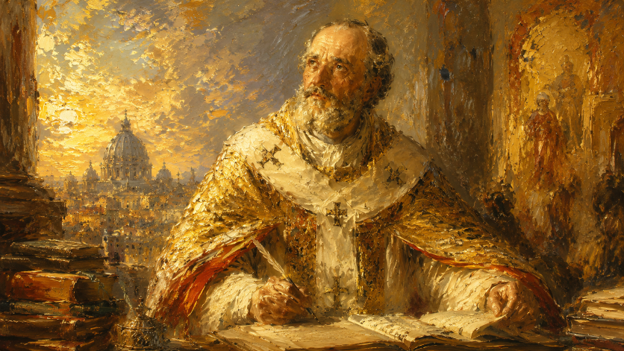
Gregory the Great, the pope even Calvin had to admire
There are few things in Christian history stranger than a Protestant praising a pope. Either something has gone badly wrong, or something very interesting is happening.
With Gregory the Great, it is the second.
Roman Catholics know him as Pope St. Gregory I, bishop of Rome from 590 to 604, Doctor of the Church, and one of the four great Latin fathers alongside Ambrose, Augustine, and Jerome. The Eastern churches know him as St. Gregory the Dialogist, Patriarch of the West, a saint and father whose memory belongs to the old, undivided inheritance of the Church. Protestants, who are not generally accused of keeping a shelf marked “Popes We Admire,” have also made room for him.
John Calvin praised him.
Calvin was not a mild critic of Rome. He was not a wounded medieval romantic sighing over lost unity. He was not the sort of man who would say, “Well, at least we all mean well.” Calvin was the Reformation’s great prosecuting attorney against the papacy.
And yet Calvin praised Gregory.
Not vaguely. Not sentimentally. Directly.
In the Institutes, Calvin’s great theological and polemical work, he appeals to Gregory’s protest against the title “universal bishop.” The Patriarch of Constantinople had been associated with that grand title, and Gregory objected with remarkable force. Gregory said that whoever called himself, or wished to be called this, is the precursor of Antichrist.
Gregory’s most explosive Latin phrase was not merely “universal bishop,” but universalem sacerdotem, “universal priest.” That matters. Gregory’s point was that the Church does not have many priests in competition with Christ. It has one true Priest, Jesus Christ, whose priesthood is represented and served by earthly ministers. A man who claims to be the universal priest obscures the one priesthood that belongs to Christ alone.
This is one of the great statements in ecclesiastical history.
Calvin noticed. Of course he noticed. Calvin had the eye of a lawyer and the memory of a scholar. Gregory’s rejection of universal episcopal grandeur gave Calvin exactly what he needed: a pope of Rome testifying against later papal overreach. Calvin says Gregory’s cause in that controversy was “good and honorable.” Coming from Calvin, this is not a polite compliment. It is evidence entered into the record.
This is the origin of the phrase often associated with Gregory among Protestants: “the last good pope.” The phrase is useful because it captures the strange position Gregory occupies. He stands at a hinge in Christian history. Behind him lies the age of the fathers, councils, monks, bishops, Scripture, and old Rome coughing nobly in the ruins of empire. Ahead of him lies the Middle Ages: missions, monasteries, chant, liturgical order, papal administration, feudal entanglements, relics, reforms, and abuses.
Gregory belongs to Rome. But not only to Rome.
That is what makes him so valuable for Nicene Christians. He is one of those rare figures whom nearly all Christians who confess the Creed can admire without having to pretend their disagreements are small. Roman Catholics, Eastern Orthodox, Protestants and sober Evangelicals can all meet him with at least one hand not yet reaching for a denominational weapon.
This does not mean Gregory solves the papal question. He does something more interesting. He makes the papal question harder to caricature.
Gregory was born around 540AD into Roman nobility, though by then Roman nobility was not quite what it had been. The Western Empire had fallen. Italy had been battered by war, famine, plague, and invasion. Rome was still Rome, but increasingly in the way an old man in a moth-eaten tuxedo is still “dressed for dinner.”
Gregory received the education of a Roman aristocrat and became prefect of Rome, one of the highest civic offices in the city. This matters. When he later became pope, he was not merely a holy man who wandered accidentally into administration. He knew how cities worked. He knew law, property, diplomacy, supply, and that most baffling of earthly mysteries: getting officials to do something useful.
Then he did something alarming, which is to say something Christian. He turned from public honor toward the monastic life. He used his family estate on the Caelian Hill to found a monastery and became a monk. One imagines the relief. Silence. Psalms. Scripture.
Naturally, the Church noticed he was happy and put a stop to it.
In 590, after plague carried off Pope Pelagius II, Gregory was elected bishop of Rome. He did not want the office. This is one of the first arguments in his favor. Men who desire power too eagerly are history’s villains. Gregory accepted authority as a burden, not as a long-delayed recognition of his obvious magnificence.
He wanted contemplation and got Rome. He wanted silence and got barbarians at the gate. He wanted psalmody and got plague relief. He wanted holiness and got meetings. The man was practically martyred by paperwork.
Rome was in crisis. Famine threatened. Disease stalked the city. Imperial power was weak. The barbaric Lombards pressed in. The old civic structures were failing. Gregory had to become pastor, administrator, diplomat, relief organizer, landlord, preacher, theologian, and emergency manager. He did not inherit a mansion so much as a burning building.
And he worked.
He organized care for the poor. He managed papal lands for relief. He negotiated with enemies. He corrected bishops. He guided missionaries. He preached. He wrote letters by the hundreds. He governed because someone had to, and because Christian charity is not a theory. Hungry people cannot eat ecclesiology.
This is why Roman Catholics rightly honor him. Gregory shows the papacy at its best: not as swagger, but as service; not as a crown, but as a cross; not as domination, but as care. His famous style, “servant of the servants of God,” was not pious lace sewn onto institutional ambition. In Gregory’s mouth, it was an argument. Authority was real, but it was dangerous. The higher a bishop rose, the easier it became for him to confuse his own voice with thunder.
Gregory knew that danger. Calvin knew that Gregory knew it. That is why Gregory mattered so much to the Protestant critique.
For Calvin, Gregory was not useful because he was secretly Reformed. He was not. Gregory was sacramental, monastic, ascetic, hierarchical, miracle-friendly, and very much a bishop of Rome. But Calvin did not need Gregory to be Protestant. He needed him to be honest. Gregory’s protest against the title “universal priest” showed that an earlier pope could reject precisely the kind of ecclesiastical inflation Protestants later found intolerable.
That is the force of the matter. Calvin was not saying, “The papacy is acceptable because Gregory was admirable.” He was saying something sharper: “The later papacy is suspect because Gregory was better.”
It is a devastating form of praise.
Gregory’s own writings explain why he could be admired across the Christian world. His Pastoral Rule may be his most practically important book. It is a manual for bishops and pastors, but it should be read by anyone entrusted with human beings: ministers, teachers, parents, editors, nonprofit directors, and possibly committee chairs, though one must not become reckless with hope.
The book asks who should become a pastor, how a pastor should live, how different kinds of souls require different kinds of counsel, and how the pastor must guard against pride. Gregory understood that leadership is spiritually dangerous. The pastor must be high enough to guide and low enough to serve. He must speak differently to the proud and the timid, the rich and the poor, the cheerful and the melancholy, the impulsive and the sluggish.
Modern leadership books tell us to cast vision, build influence, tell our story, maximize our platform, and possibly record a podcast in which we explain our morning routine. Gregory tells pastors to tremble. He is better.
His Pastoral Rule is also a rebuke to the sentimental view of ministry. Gregory does not imagine pastoral care as vague niceness delivered in soft lighting. It is surgery. The wrong word can wound. The right word can heal. The pastor is not a religious entertainer or institutional mascot. He is a physician of souls, and bad physicians kill people while smiling warmly.
Then there is the Moralia in Job, Gregory’s massive commentary on Job. It is huge, strange, brilliant, excessive, profound, and occasionally almost as exhausting as Job’s friends. It is not a modern commentary. Gregory is not interested in limiting himself to what would pass peer review in a faculty lounge. He reads Job historically, morally, allegorically, and Christologically.
This does not mean he is uninterested in the question of righteous suffering. He is deeply interested in it. But he does not approach Job chiefly as a philosophical theodicy, an inquiry into the justice of God. He is not primarily trying to win the seminar debate: “How can God allow innocent suffering?” He is trying to form the soul that suffers.
For Gregory, Job is a historical righteous man. He is also a moral mirror in which the reader sees his own soul. He is a figure of Christ, the innocent sufferer. He is an image of the Church under trial. A modern philosopher may ask, “Can God be justified?” Gregory asks, “What does suffering reveal? What does it purify? How does pride hide in prosperity? How does patience work? How do false comforters make everything worse while congratulating themselves on their theological seriousness?”
Gregory gives us theodicy absorbed into spiritual formation. He is less interested in clearing God in court than in keeping the sufferer from spiritual collapse. This is a useful difference. A man in anguish does not usually need clever philosophy. He needs truth, humility, repentance, patience, hope, and perhaps fewer visitors like Eliphaz, Bildad, and Zophar, the original board of directors for unhelpful religious advice.
The Dialogues show another side of Gregory. These stories of Italian saints, monks, miracles, visions, holy deaths, and divine interventions helped form the medieval Christian imagination. Book II is especially important because it preserves the most influential early life of Benedict of Nursia. Without Gregory, Benedict would still matter; with Gregory, Benedict became one of the defining fathers of Western monasticism.
Modern readers often squirm at the miracle stories. We are sophisticated people. We believe in black holes, quantum fields, artificial intelligence, market bubbles, and printers that can sense fear. But miracles? Let us not be naïve.
Gregory was not embarrassed by a porous world. He believed holiness left traces. He believed stories could teach what propositions alone could not. He believed heaven and earth were not sealed off from one another by drywall, fluorescent lighting, and a graduate seminar on ancient credulity.
This is part of why the Eastern churches remember him as Gregory the Dialogist. In Orthodox memory he is not a papal exhibit. He is a saint of the Church: a father, teacher, ascetic, and liturgical figure. Orthodox tradition also associates him with the Liturgy of the Presanctified Gifts, a major Lenten service in Byzantine practice. The Christian East remembers Gregory not as an enemy, but as a saint of Old Rome.
That matters. Gregory is not merely a Catholic pope whom Protestants occasionally borrow for anti-papal argument. He is also a Roman father whom the Orthodox respect. This gives him a threefold importance rare among popes: Rome honors him as pope and Doctor; Geneva can call him as a witness against papal overreach; Constantinople can look to him as a saint of the old, undivided Church.
That is not ecumenism by committee.
Gregory in fact had a missionary imagination. He saw not merely foreigners, barbarians, or political abstractions, but souls. According to the tradition, he wanted to go to England as a missionary but was prevented. Later, as pope, he sent Augustine of Canterbury and about forty monks to evangelize the Anglo-Saxons. They arrived in Kent in 597.
Gregory’s Homilies on the Gospels show him as preacher: direct, pastoral, morally urgent, full of Scripture applied to ordinary Christians. His homilies on Ezekiel show him as allegorical interpreter, reading prophetic vision as instruction in watchfulness, contemplation, preaching, and the life of the Church. His letters show him as administrator in the trenches: famine, bishops, monks, estates, missions, complaints, scandals, politics, poor relief, and the permanent human ability to turn any simple matter into a jurisdictional crisis.
His other works fill out the picture. The Commentary on First Kings reflects his concern with authority, obedience, pride, kingship, and spiritual government. His material on the Song of Songs shows the contemplative side: the love of God and the soul, Christ and the Church, desire purified into prayer. The chant traditions connected with his name are historically complicated, but symbolically important. Gregorian Chant is named for him, though modern scholars are cautious about imagining him personally composing the whole body of chant. Medieval art loved to picture the Holy Spirit as a dove whispering music into his ear. It is a beautiful image, and certainly nicer than any modern equivalent.
Whether or not Gregory wrote the chant attributed to him, the legend says something true. He became the great symbol of ordered Roman worship. Prayer, doctrine, beauty, discipline, and pastoral seriousness belonged together. He was not a man who thought worship should be casual because God is gracious. God is gracious; that is why worship should not be tacky.
So why does Gregory matter now?
Because he gives all Nicene Christians a shared father without giving any of them an easy victory.
Catholics can honor him as pope and Doctor of the Church. But Gregory also warns Catholics that papal authority must never become ecclesiastical self-intoxication. His rejection of the title “universal priest” does not settle every Catholic-Protestant or Catholic-Orthodox dispute. It does not erase later Catholic doctrine by magic. But it does restrain triumphalism. Gregory’s authority was real, but it was pastoral, fearful, and servant-shaped. He was a pope, not a peacock.
Protestants can honor him without surrendering the Reformation. Indeed, Calvin’s use of Gregory proves that. Calvin did not quote Gregory because he had gone soft on Rome. He quoted Gregory because Gregory gave him evidence. A pope of Rome had condemned the instinct toward universal episcopal grandeur. For Calvin, Gregory was not an exception that weakened the Protestant critique; he was a witness that strengthened it.
That is the great irony. The fiercest critic of the papacy at the height of the Reformation did not need to deny that Gregory was great. He needed Gregory to be great. Calvin’s argument works because Gregory is not a marginal figure. He is not an obscure crank in a remote corner of ecclesiastical history. He is Gregory the Great, bishop of Rome, father, saint, pastor, missionary, writer, administrator. If such a man rejected the inflated title, then later claims could not simply be waved through as the obvious inheritance of the early Church.
The Orthodox can honor Gregory without accepting later Roman supremacy. Indeed, Gregory is especially congenial to Orthodox memory because he is Pope of Rome before the later estrangement hardened into schism. He belongs to the world of fathers, councils, liturgy, asceticism, and episcopal dignity without requiring the East to accept Vatican I by historical ambush. He is Roman, yes. But he is Old Rome, the Rome of saints and fathers, not merely Rome as an argument about jurisdiction.
In that sense, Gregory is a Christian common ancestor. He does not make Rome, Geneva, and Constantinople agree. He makes their disagreement more honest. He does not abolish the Reformation. He complicates Protestant amnesia. He does not make Orthodoxy Roman. He reminds the East that Rome gave saints to the whole Church. He does not make Catholicism Protestant. He reminds Catholics that authority is most Christian when it fears pride.
This is the kind of ecumenism worth having. Not the bland kind in which everyone agrees to speak warmly and say nothing. Gregory gives us something better: a shared father who irritates all his children in different ways.
He irritates Catholics by sounding less papalist than later papal theory might prefer. He irritates Protestants by being unmistakably Catholic, sacramental, monastic, hierarchical, and miracle-friendly. He irritates the Orthodox by being a pope of Rome too holy to dismiss. He irritates moderns by believing in asceticism, allegory, miracles, judgment, hierarchy, and the care of souls. He irritates church administrators by having been both holy and administratively competent, which removes popular excuses.
Excellent. That is what fathers are for.
A mascot exists to flatter a tribe. A father exists to make the tribe grow up.
Gregory’s flaws should not be hidden. His allegories sometimes run wild. His miracle stories will trouble rationalists. His Roman identity will trouble some Orthodox polemicists. His pastoral severity will trouble an age that thinks kindness means never saying anything that might be remembered.
But greatness is not harmlessness. Gregory is great because he is whole. He is contemplative and administrative, Roman and catholic, monastic and missionary, intellectual and practical, liturgical and charitable, severe and merciful. He knew Scripture had depths. He knew leaders were in danger. He knew suffering could purify without ceasing to hurt. He knew the poor needed food before they needed a position paper. He knew worship mattered. He knew clergy should be humble.
“The last good pope” is therefore too useful to discard. It captures the strange historical fact that Gregory stands before later hardenings: before Rome’s claims reached their medieval and modern forms, before Protestant rejection took confessional shape, before East and West became estranged in the way they later did.
He is one of the last great Romans and one of the first great medievals. He is a pope admired by Calvin, a Roman bishop venerated by the Orthodox, a Doctor honored by Catholics, and a pastor still worth reading by anyone responsible for souls.
That combination is rare. Most church leaders are fortunate if their own side can defend them without changing the subject.
Gregory gives us a better possibility: not agreement without truth, but memory without amnesia. Catholics need not stop being Catholic to hear Calvin’s point. Protestants need not stop being Protestant to admire a pope. Orthodox Christians need not stop being Orthodox to venerate a Roman father. Gregory does not abolish the arguments. He gives the arguments better manners, better history, and better company.
He makes Rome less triumphalist, Geneva less dismissive, and Constantinople less tempted to forget that Old Rome once gave the Church saints of tremendous stature.
For a man who wanted to be a monk and got stuck managing the collapse of civilization, that is not bad.
For a pope praised by Calvin, honored by Catholics, and venerated by the Orthodox, “Great” seems almost modest.