
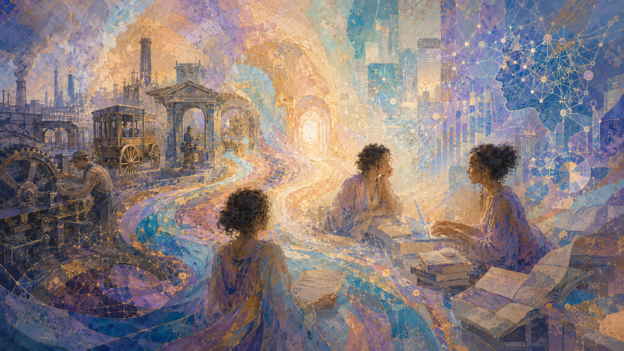
The apocalypse apparently begins when automation learns to write emails.
Trying to avoid artificial intelligence is beginning to feel like trying to opt out of gravity.
It is already everywhere. It has spread seamlessly through phones, search engines, office software, customer-service systems, and design platforms. Microsoft calls it Copilot. Salesforce calls it Einstein. Canva calls it Magic. These are just branding exercises, polite euphemisms intended to make artificial intelligence sound less alarming. But beneath the reassuring names lies the same reality: AI, AI, AI.
You may dislike it. You may fear it. You may write passionately worded essays declaring that it will destroy civilization, democracy, education, human creativity, and possibly the family dog. Yet AI continues to spread through society with the quiet inevitability of electricity flowing through a wire.
This has happened before.
In the nineteenth century, the light bulb did not merely improve candles. It transformed civilization. The inventors and early adopters could scarcely have imagined radio, television, satellites, the internet, social media, or artificial intelligence itself. Electricity was not simply a product. It was a platform upon which entirely new categories of human life would eventually be built.
Artificial intelligence appears likely to be similar.
And yet our response to AI has revealed something mildly sinister about modern society.
For generations, technological disruption was treated as the natural order of things, particularly when it happened to working-class people.
When the light bulb replaced lamps lit by whale oil, the whaling industry collapsed. I suspect few editorials mourned the endangered career prospects of professional harpooners. The automobile annihilated entire horse-based economies: blacksmiths, stable hands, carriage makers, saddle craftsmen, wagon manufacturers, breeders, and countless related trades. Society did not declare a national emergency.
The answer was simple: adapt.
Factories automated. Farms mechanized. Coal towns emptied. Steel jobs vanished. Assembly lines became robotic. Bank tellers shrank in number. Travel agents largely disappeared. Retail chains were hollowed out by the “retail apocalypse” brought on by Amazon and online shopping. Newspapers and publishing suffered catastrophic disruption from the internet. Entire local papers evaporated. Classified ads, which were once a dependable source of newspaper revenue, were casually murdered by Craigslist.
Again and again, people were told the same thing: this is progress. Learn new skills. Move. Adjust. The market has spoken.
My own uncle worked as a toll taker on the Pennsylvania Turnpike. Then came automation. EZPass did not hate him personally. It simply rendered his job economically unnecessary. No national soul-searching followed. Nobody suggested banning technology to preserve the toll booth as a sacred human institution.
But now something fascinating has happened.
Artificial intelligence is not primarily threatening mechanics, warehouse workers, or drivers, at least not at first. It is coming for writers, coders, accountants, designers, analysts, paralegals, marketers, consultants, customer service departments, and perhaps eventually portions of medicine, education, law, and finance.
It may also threaten one of the less beloved branches of the professional economy: the college credentialing racket. For decades, diploma mills and bloated graduate programs have sold young people the promise of middle-class security at prices that would embarrass a loan shark, then left them with crippling debts that even bankruptcy cannot erase. If AI can teach, tutor, explain, translate, draft, assess, and help people demonstrate actual competence, it may eventually ask an impolite question: how much of higher education is education, and how much is a very expensive permission slip into the credentialed world?
In other words, AI is arriving in the professional classes.
Suddenly, disruption is no longer an unfortunate but acceptable byproduct of progress. It is an ethical crisis. We are informed that AI threatens “human dignity,” “meaningful work,” and “the social fabric.” Congressional hearings are held. Think pieces multiply like rabbits in springtime. Professors who once assured coal miners that globalization was inevitable now write anxious essays explaining why society must slow down technological change.
I have to ask, where was this tenderness when factories closed?
This does not mean the concerns about AI are entirely wrong. On the contrary, some of them are quite serious. AI could indeed reshape labor markets dramatically. It may centralize power dangerously. It could flood society with propaganda, fraud, synthetic relationships, and intellectual laziness. Nor can we ignore the very real environmental concerns. Like every revolutionary technology, it will create moral and cultural problems alongside economic opportunities.
But the selective panic is revealing.
When blue-collar workers suffered displacement, society spoke the language of efficiency. When white-collar workers face disruption, society suddenly rediscovers the language of humanity. Blue-collar workers were told to adapt. Now white-collar workers are asking whether society can survive innovation. Working-class people endured centuries of technological displacement with little elite sympathy. Now that automation threatens educated professionals, society suddenly treats disruption as morally alarming. AI is not the first technology to destroy livelihoods. It is the first in a long time to threaten the people who write the think pieces.
And yet AI may also become one of the most liberating technologies ever created.
For people with disabilities, AI tools are already astonishing. They can assist with communication, organization, mobility, translation, reading, writing, and social interaction. A nonverbal person on the autism spectrum may communicate more naturally. Someone with physical limitations may suddenly possess extraordinary productive capacity. A blind person can navigate the world more independently. AI-powered glasses can already read signs aloud to the visually impaired, narrating the physical world in real time. It is difficult to dismiss a technology as wholly dystopian when it helps blind people read street signs.
More broadly, AI can dramatically amplify human effectiveness. A small business owner can perform tasks once requiring an entire staff. Researchers can process information at extraordinary speed. Teachers can personalize instruction. Clerical burdens can shrink. Creativity itself may become more accessible to ordinary people.
The printing press caused disruption. (The Protestant Reformation would have been impossible without it.) So did recorded music, radio, television, the electric guitar, calculators, and the internet.
Now comes AI.
The honest position is neither utopian enthusiasm nor theatrical despair. It is humility. The inventors of electric light could not have imagined TikTok, nor should we pretend we fully understand where artificial intelligence will lead. Technologies often become foundations for developments that are incomprehensible at their birth.
AI may indeed alter civilization as profoundly as electricity did.
But if society wishes to have a serious moral conversation about technological disruption, perhaps we should begin by admitting that the problem did not suddenly appear the moment software started threatening people with graduate degrees.
[Ironically, this article was not written using AI except to smooth the grammar in the final draft.]